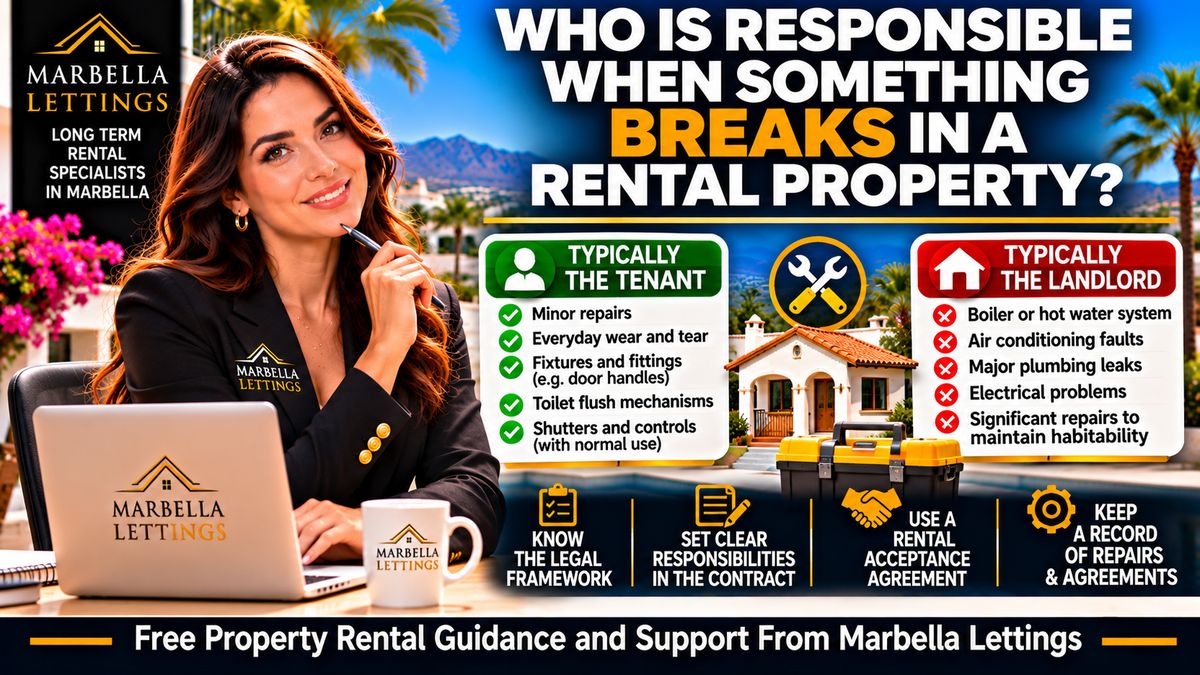
The short answer: In a Marbella long-term rental, the owner is responsible for the property’s essential systems: the boiler and hot water, air conditioning, supplied appliances, electrics, plumbing and major leaks. The tenant is responsible for the small, everyday fixtures they use constantly, such as door handles, toilet flush buttons, shutter straps and cupboard hinges, which were working when they moved in. Spanish law supports this split, but the word “habitable” is often stretched to cover everything. The best protection is agreeing where the line sits, in writing, before the tenant moves in.
Here’s a situation we see more often than you might expect. A tenant has lived in a San Pedro Alcántara apartment for 18 months. The bathroom door handle comes away in their hand. They report it, and they’re told that small repairs from everyday use are theirs to sort out.
A week later, an email arrives from the tenant’s lawyer. It says the owner has a legal duty to keep the property habitable at all times, and that the handle must therefore be repaired at the owner’s expense.
So who is right? Marbella Lettings are long term property rental specialists in Marbella, and after more than 20 years managing long-term rentals, this is one of the most common disputes we deal with. The law itself isn’t the problem. The problem is where people draw the line.
The Grey Area Nobody Defines: What Does “Habitable” Mean?
Spain’s Urban Leases Act (LAU) says, in Article 21, that the owner must carry out the repairs needed to keep the property in a habitable condition. That’s the sentence lawyers tend to quote.
But the same article also says that small repairs required by wear and tear from ordinary use are the tenant’s responsibility. That part is often left out of the email.
“Habitable” isn’t defined as “everything in perfect working order”. In practice, it means the property can safely be lived in: it has water, electricity, sanitation, hot water and heating where installed, a sound structure, and can be locked and secured. A loose door handle doesn’t make a home uninhabitable. Nor does a sticking cupboard door or a worn flush button.
So when a lawyer tells us the owner must fix something because the property must be habitable, our reply is simple and polite: which specific legal provision makes this particular item the owner’s responsibility? Very often, the answer turns out to be the general habitability duty, which doesn’t cover small everyday repairs.
Where We Draw the Line: The “Working on Day One” Principle
Our approach is straightforward. If an item was working when the tenant moved in, and it’s something the tenant uses every single day, then wear and tear on it is a small repair from ordinary use, and it’s the tenant’s to fix.
Think about how often these things are used. A bathroom door handle may be turned ten times a day: over 18 months, that’s more than 5,000 times. A toilet flush button is pressed constantly. Shutters in a sunny Marbella apartment go up every morning and down every evening. Eventually, through ordinary use, something gives. That’s not a fault in the property. It’s the natural result of living there, and it’s exactly what the law means by small repairs from ordinary use.
Equally, the owner should never be asked to pay for an item the tenant has simply worn out, any more than a tenant should pay for a boiler that has failed through age.
Owner or Tenant? Where the Line Usually Falls
| Usually the tenant (everyday-use fixtures) | Usually the owner (essential systems) |
|---|---|
| Door handles and internal locks | Boiler and hot water system |
| Toilet flush buttons and cistern parts | Air conditioning units |
| Shutter straps, cords and winders | Supplied appliances: fridge, oven, washing machine |
| Cupboard hinges and handles | Electrical installation and fuse board |
| Light bulbs and fuses | Major leaks and pipework |
| Tap washers and showerheads | Damp, water ingress and structural problems |
| Blocked drains from everyday use | Shutter motors failing through age |
Notice the last line. There’s a difference between a shutter strap that snaps after a year of daily use, which is a small everyday repair, and an electric shutter motor that burns out after twelve years, which is the failure of an installation. Being fair about that difference is what makes the line credible to tenants, lawyers and owners alike.
And if something breaks within days of moving in, or was already faulty, it was never working on day one, and it’s the owner’s responsibility.
Does a Broken Shutter Make a Property Uninhabitable?
This is the question that starts the most arguments. In almost all cases, no. A shutter that won’t roll up is inconvenient, but the property still has light, water, power and security.
There are sensible exceptions. A ground-floor shutter that is the only way to secure the property overnight is a security issue, and security does affect habitability. Context matters, which is why we always look at the actual impact rather than applying the word “habitable” to every request.
When “Habitable” Becomes Leverage
In our experience, the difficulty often comes next. Some tenants, having been told a repair is theirs, start using the habitability argument as leverage: “I won’t pay the rent until it’s fixed,” or “I’ll have it repaired and take it off next month’s rent.”
Here’s the legal position. Since 8 October 2026, a new procedure (Article 21.5 of the LAU, added by Real Decreto-ley 29/2026) does allow a tenant to deduct repair costs from future rent, but only in specific circumstances:
- The damage must affect the property’s habitability, safety or health.
- The tenant must send a written request with a reasonable quote.
- The owner then has 15 calendar days to accept the quote, offer an alternative, or carry out the repair.
- Only if the owner doesn’t respond, or refuses without good reason, can the tenant do the work and deduct the reasonable, documented cost.
A loose door handle or worn flush button doesn’t affect habitability, safety or health, so this procedure doesn’t apply to them. Outside this process and the separate rule for genuine emergencies, a tenant can’t simply withhold rent or deduct repairs.
But there’s an important lesson for owners too. For genuine faults, such as a failed boiler or a serious leak, a slow response now has real consequences. That’s why we respond to every repair request quickly, even when we believe the repair is the tenant’s. The new rule also still needs confirmation by the Spanish Parliament, so always check the current position with a lawyer.
Agreeing the Line Before Move-In: Our Rental Acceptance Agreement
Most of these disputes can be prevented before the tenant ever receives the keys. As Marbella Lettings are long term property rental specialists in Marbella, we ask every tenant to sign a Rental Acceptance Agreement at check-in, alongside a detailed, photographed inventory.
The agreement sets out clearly:
- The tenant’s side: looking after the property, reporting faults promptly, and handling basic maintenance of the fixtures and fittings they use every day.
- The owner’s side: the boiler, air conditioning, supplied appliances, electrics, plumbing, major leaks and the property’s structure.
- The condition at check-in: photographs and notes showing everything working on day one.
This doesn’t override Spanish law, and it can’t remove any legal right, including the new repair procedure. What it does is make expectations clear from the start and provide evidence of the property’s condition if a question arises later. In our experience, a tenant who has read and signed it rarely disputes a door handle.
What to Do When a Lawyer’s Email Arrives
- Stay calm and polite. A lawyer’s email is a starting point, not a verdict.
- Ask for the specific legal basis for the item in question, not just the general habitability duty.
- Share the evidence: the signed acceptance agreement and the check-in inventory showing the item working.
- Get a technician’s view on the cause if it isn’t clear whether it’s wear, misuse or a defect.
- Offer a sensible solution where it’s genuinely borderline. Sometimes sharing a small cost is cheaper than a long dispute.
- Take your own legal advice if it escalates.
Having one professional point of contact handling these conversations helps enormously, as we explain in our article on keeping a professional line between landlord and tenant.
Final Thoughts
The question isn’t really “who is responsible when something breaks?” It’s “where do you draw the line?” Our answer, after more than 20 years: the owner looks after the property’s essential systems, and the tenant looks after the everyday fixtures they use, which were working when they moved in.
“Habitable” is a real legal duty, but it isn’t a catch-all. Agree the line in writing at check-in, record the property’s condition, respond quickly to every report, and most repair disputes never happen.
Frequently asked questions
Who pays when a door handle breaks in a Spanish rental?
If it was working at check-in and has worn out through everyday use, it’s generally a small repair from ordinary use, which the LAU places on the tenant.
Does “habitable” mean the landlord must fix everything?
No. Habitability covers essentials like water, electricity, sanitation, hot water, structural safety and security. Small everyday repairs remain the tenant’s responsibility.
Is a broken shutter the landlord’s or the tenant’s responsibility?
A worn strap or cord from daily use is usually the tenant’s. An electric motor that fails through age is usually the owner’s. A shutter needed to secure the property is treated more seriously.
Can a tenant withhold rent until a repair is done?
No. Since 8 October 2026, tenants can deduct documented costs only for serious faults affecting habitability, safety or health, after a written request and 15 days without a proper response.
What is a Rental Acceptance Agreement?
A document signed at check-in that sets out the tenant’s and owner’s maintenance responsibilities and records the property’s condition, so expectations are clear from day one.
What should a landlord do if a tenant’s lawyer gets involved?
Ask for the specific legal basis, share the check-in evidence, get a technician’s view on the cause, and take your own legal advice if needed.
Thinking about letting your Marbella property, or looking for somewhere to rent?
Let your property long term Browse rentals